“The destruction of the Regiment weighs heavily on my heart …”
Share the post "“The destruction of the Regiment weighs heavily on my heart …”"

“The destruction of the Regiment weight heavily on my heart. The current-serving decision makers do not care about heritage, history or loyalty. Their silence in this matter says it all. Rank disregard for those affected!”
Colin Toll (Commanding Officer, 1st Armoured Regiment, 1979-81)
Chief of Army has stated that “the Australian Army’s future is fighting on the beaches, rivers, coastal waters and archipelagos of the Indo-Pacific”.
An essential element of the projection of land power in the littoral region, relates to seizing and controlling vital terrain and infrastructure. Tanks are an important asset here, because their mobility and situational awareness enable them to deploy quickly and bring their firepower to bear exactly where needed. Unsurprisingly, they’re at the very centre of the ADF’s combined-arms fighting system.
Because of their versatility, tanks can be used in a wide range of scenarios, environments and levels of conflict in the region. They can also operate very successfully in medium- to high-threat environments. One thing’s certain, whoever we’re fighting on the beaches and archipelagos, will be well supported. The battle for air superiority, for example, will be intense.
Notwithstanding this, the enemy’s airborne forces could well be used to secure strategic locations. This is another area, of course, where tanks can provide the response needed … they provide the perfect combination of mobility, firepower and protection.

Why is it then, that 1st Armoured Regiment has been stripped of its tanks and Australia’s only armoured brigade (Townsville) has to operate light a tank squadron, a reconnaissance squadron and a battlegroup headquarters … a significant reduction in its combat power and degradation of the brigade’s training potential?
Why? Because there was a need for a unit to evaluate new technologies. Unfortunately, the need was long overdue; so much so, that the new body had to ‘hit the ground running’. Forming a new unit, just wouldn’t ‘cut it’ … an existing one had to be sacrificed.
So, despite its 75 years’ service, the unique honour of having been presented with a Standard and being awarded three battle-honours and a Unit Citation for Gallantry for service in Vietnam, 1 Armd Regt had to go. Albeit, not literally. The unit still exists, BUT …
The Role of the Royal Australian Armoured Corps (RAAC) is to “locate, identify, capture and destroy the enemy, by day or night, in combination with other arms, using fire and manoeuvre”. As is readily apparent, the Armoured Corps is a combat arm. It follows that there is no place within it for an experimentation unit.
Chief of Army, however, is the man at the top. If others wish to get their turn, they have to ensure that his needs are satisfied. So it was that 1 Armd Regt (formerly part of the RAAC) became an experimentation unit. As the saying goes: ‘No correspondence will be entered into!’.
Not only was no discussion tolerated, but all formal RAAC entreaties were knocked back as well. Surprisingly, the whole matter was clocked in secrecy. Nobody has been able to work out why.
Has anyone in the current Defence leadership team, actually experienced combined arms operations? Do they appreciate the skills that are needed to destroy the enemy using fire and manoeuvre, and the amount of training needed to maintain them?
Presumably, the CA’s view is that this doesn’t matter.
If it did, 1 Armd Regt wouldn’t have been destroyed and 3 Brigade (armoured) wouldn’t have lost a third of its combat power.
As a member of the Army History Unit once said: “It is relatively easy to get someone to record battlefield experiences … what is much harder, is getting others to sit down and open the book”.
Living memory is still available to call upon, albeit … only just!
Disappointingly, however, it’s a commodity no longer valued – one which will soon disappear (until the next ‘war’).
Lieutenant Colonel Bruce Cameron, MC, RAAC (Ret’d)
.
.
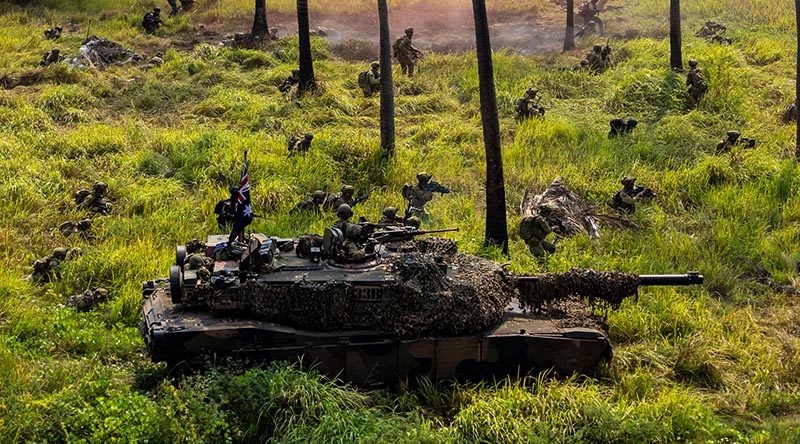
FILE PHOTO: Australian Army M1A1 Abrams tank and Australian Army personnel from the Amphibious Force and Indonesian National Armed Forces marines move inland from Banongan Beach, East Java, during Exercise Keris Woomera 2024. Photo by Andrew Green.
.
.

.
.
Share the post "“The destruction of the Regiment weighs heavily on my heart …”"